If you want to manage a company consistently as a brand, you inevitably have to deal with its brand character. The path to a defined brand identity can be started in various ways. One of the most practical and versatile tools for us at superspring is that of brand archetypes. A simple tool that can be used to develop effective positioning.
Every successful brand is a character and has personality. They are part of an idealized reality in that they exaggerate certain characteristics and make them tangible for us all. We can all describe the personality of our favorite brands: Friendship? Coke. The world's knowledge? Google. Fun and crazy ideas: tiktok.
But what sounds simple is not always so. As a brand personality, we define thewhat really counts for a brand: How it acts, presents itself and is perceived holistically by customers. Brands are not always thought of consistently in their planning or implemented stringently in their appearance - although this is absolutely important.
As a Marketing and innovation consultancy , we at superspring often work with brands in the start-up or relaunch phase.We help decision-makers position their organizations and create brand guidelines. To do this, they need a clear idea of consistency. Because everything revolves around the question: How does the brand want to establish itself in the market in the long term and why?
We find that working with brand archetypes serves as a great strategic tool that helps us to do this. We enjoy using this psychological model in workshops to derive clear characteristics of a brand and to specify its role in our world. Brand archetypes help to explain the behavior of a brand and to define fields of activation that fit one's own brand.
What are brand archetypes?
The brand archetypes form a model that is perfectly suited for use in strategic brand management and in Branding . It is useful and understandable, deeply rooted in and derived from human psychology. The idea of archetypes is based on a Theory of Carl Jung who understood archetypes to be universal, mythical characters that are deeply rooted in the collective human psyche.
The 12 Jungian archetypes represent psychological meta-narratives that we all know and have experienced over and over again in the great stories of our world. They are stereotypes that we have described below. In marketing, these archetypes can be used to give brands a distinctive personality and thus build a long-term emotional connection with the audience. By the way, it does not matter whether it is B2C or B2B. handelt.
When used correctly, brand archetypes can help:
- Building your own brand personality
- Creating a visual identity for your brand as a whole
- Help to set up a clear Communication Strategy aufbauen helfen
- Creating identity around your brand
- Generate appropriate associations around your brand
- The use of symbols and associations with reference to your brand
- Facilitate the development of consistent content strategies
Application
In their original form, each of the 12 archetypes represents a character that, to put it simply, can play a role for a brand. Admittedly, reality is actually a bit more complex. But more on that later.
Each archetype represents a fundamental value proposition that he or she brings to the world, along with two other related archetypes. For example, the “ruler” archetype embodies Authority, but thus plays in the field stability (see below). The “rebel” wants to change the world stands next to the hero and the magician for Self-serving values, in which the world is to be left with his mark.
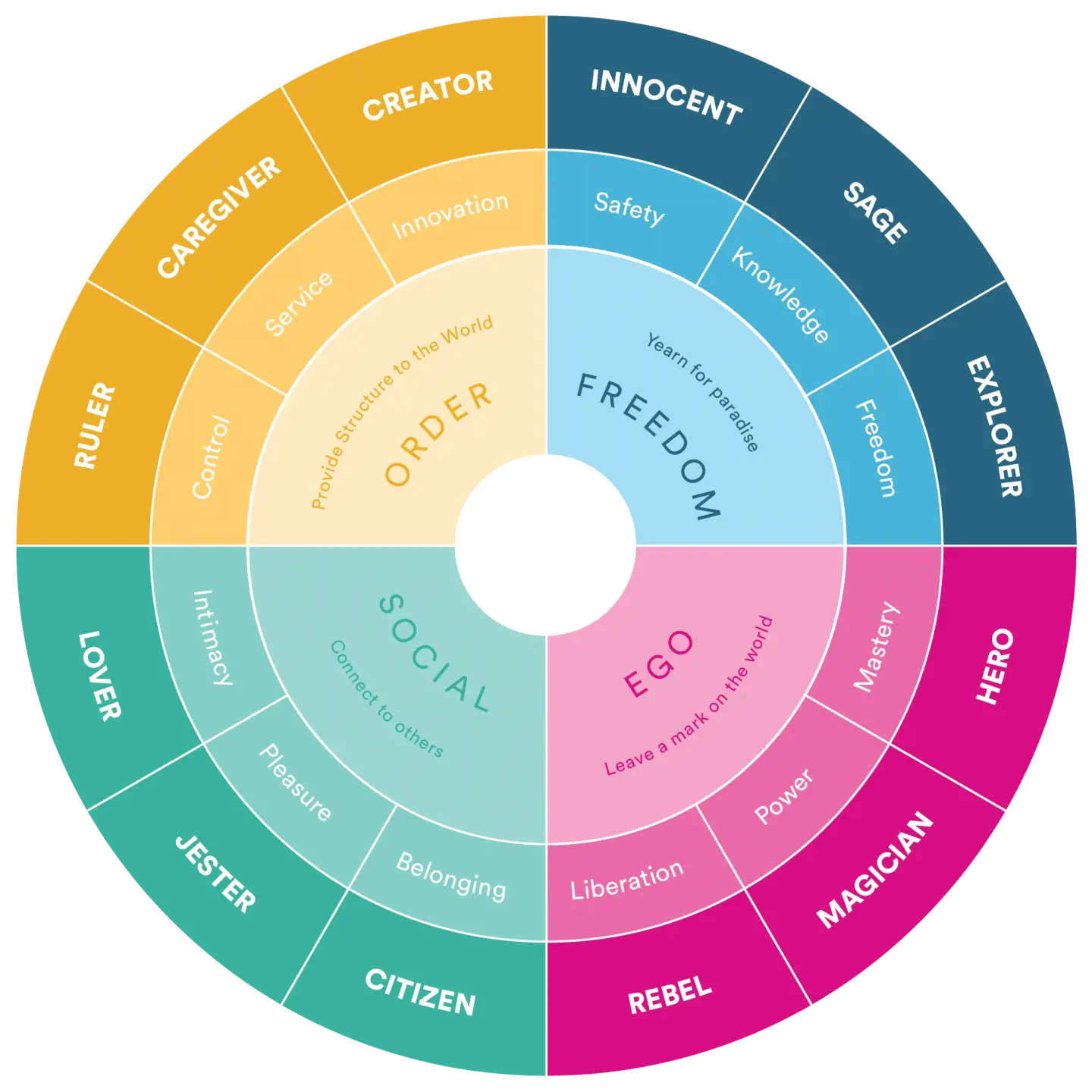
These two examples already reveal the basic way in which archetypes work. As a model, they help us to stimulate our imagination and reflect on the impact of brands. At the same time, they allow us to formulate measures that are “on strategy” and fit the brand, with a view to the specific brand work after the actual brand development.
exemplary
- How would a “hero” brand (e.g. Nike) present itself? And how not?
- How would a “fool” brand (e.g. M&Ms) communicate? And how not?
- What should the look and feel of a magician's brand be like? What should a new app from such a brand do to be “on brand” and what should it not do?
Die 12 Marken-Archetypen
Every brand archetype has a role in the world and a goal. They are good at some things and not so good at others. They have strengths and weaknesses, fears and desires. And they see the world through a lens. They influence us in the same way that any strong personality does: Odysseus, Joan of Arc, Gandalf, Churchill, Taylor Swift – they all stand for something in this world. We want to debate geopolitics with Winston Churchill, but we might prefer to hear songs from Taylor Swift.
Central to this are the four fundamental fields on which all brand archetypes are based: Freedom, Ego, Social, or OrderEach of these fields represents an idealized view of things in which the assigned archetypes want to or can have a share. Archetypes strive for a better world in which they believe, which they can help create, and for which they want to inspire others. Brands can use these 12 personalities to model themselves more consistently and create things that are consistent and understandable in terms of their brand. – and, of course, to create understanding for brand management internally.
3rd quadrant: Social
Aren't we all looking for a little breathing room and freedom? Brands committed to the freedom quadrant want to help people reach a new spiritual level and recognize things that only they can see. The archetypes of the freedom quadrant seek self-fulfillment through various paths that bring them closer to their ultimate goal.
The Innocent as an Archetype

The Innocent symbolizes optimism, positivity, and simplicity. Curious, positive, and spontaneous, Innocents believe in the best in people. Innocents seek a world of harmony and this sometimes challenges the world. When a chaotic world doesn't quickly become as harmonious as Innocents want it to be, it can sometimes feel like childish defiance.
The innocent archetype for brands:
Brands that follow the innocent archetype focus on simplicity and convey the feeling that life can be easy and carefree. They strive for harmony and motivate through optimism and trust. Innocent brands offer security and a sense of belonging, promoting feelings of nostalgia and naturalness. They avoid manipulation or inflammatory tendencies and instead point the way to a better tomorrow.
Attributes:
- Promise: Life can be so beautiful if you live it right.
- Objective: The search for harmonious fulfillment.
- Strategy: Live positively and do things right.
- Strengths: Faith and optimism.
- Weaknesses: Self-denial and quick disappointment.
- Motivation: Independence and fulfillment.
Brand development phases:
Brands in this field can develop in many ways. An exemplary path can include different levels of orientation towards this archetype:
- Entry level: Formulate harmonious personal happiness as a personal goal (e.g. wellness or natural products).
- Development level: Implementing a more holistic lifestyle for a better life (e.g. New Work).
- Expansion level: Orientation towards internal focus and one's own mental capacities (e.g. spiritual brands and psychological coaching offers)
Typical innocent brands:
Brands in this field often come from the lifestyle/beauty/fashion sector, but not exclusively. Examples include:
- Calm App
- NIVEA
- Kuyichi
The Sage as an Archetype

The sage focuses on knowledge and insight. Where the archetype of the innocent one went in search of a happy, carefree life, sages search for enlightenment for us all. For sages, the key to success is the tireless search for deeper truth. Sages rarely seek power for its own sake, but they help to make topics understandable and are therefore indispensable on the hero's journey.
The Sage archetype for brands:
Sage brands want to educate and share knowledge. They are therefore often brands that use analysis, knowledge and a deep opinion of our world to make it understandable. However, brands in this field not only generate knowledge, they also distribute it. What is important here is a high degree of reliability and, if possible, the avoidance of factual errors and disinformation.
Attributes:
- Promise: To bring truth to you and the world.
- Desire/goal: Understanding the world.
- Strategy: Seeking and sharing wisdom.
- Strengths: Intelligence, experience and clarity.
- Weaknesses: Fear of deception and ignorance.
- Motivation: Enlightenment.
Brand development phases:
Brands in this field can develop in many ways. An exemplary path can include different levels of orientation towards this archetype:
- Entry level: The search for knowledge and the sharing of content that makes others smarter (e.g.
- Development level: Sharing knowledge to help others, and creating moments when that happens (e.g. via conferences and events, but also via expert podcasts,
- Expansion level: Use wisdom to solve social problems with others (e.g. through social initiatives).
Typical Sage brands:
Brands in this field often create and distribute knowledge. Journalistic brands or classic analysis houses are typical examples. But not exclusively so. Many brands can also position themselves away from this field. Examples include:
- OMR
- Brand Eins
- Gartner
- TED
The Explorer as an Archetype
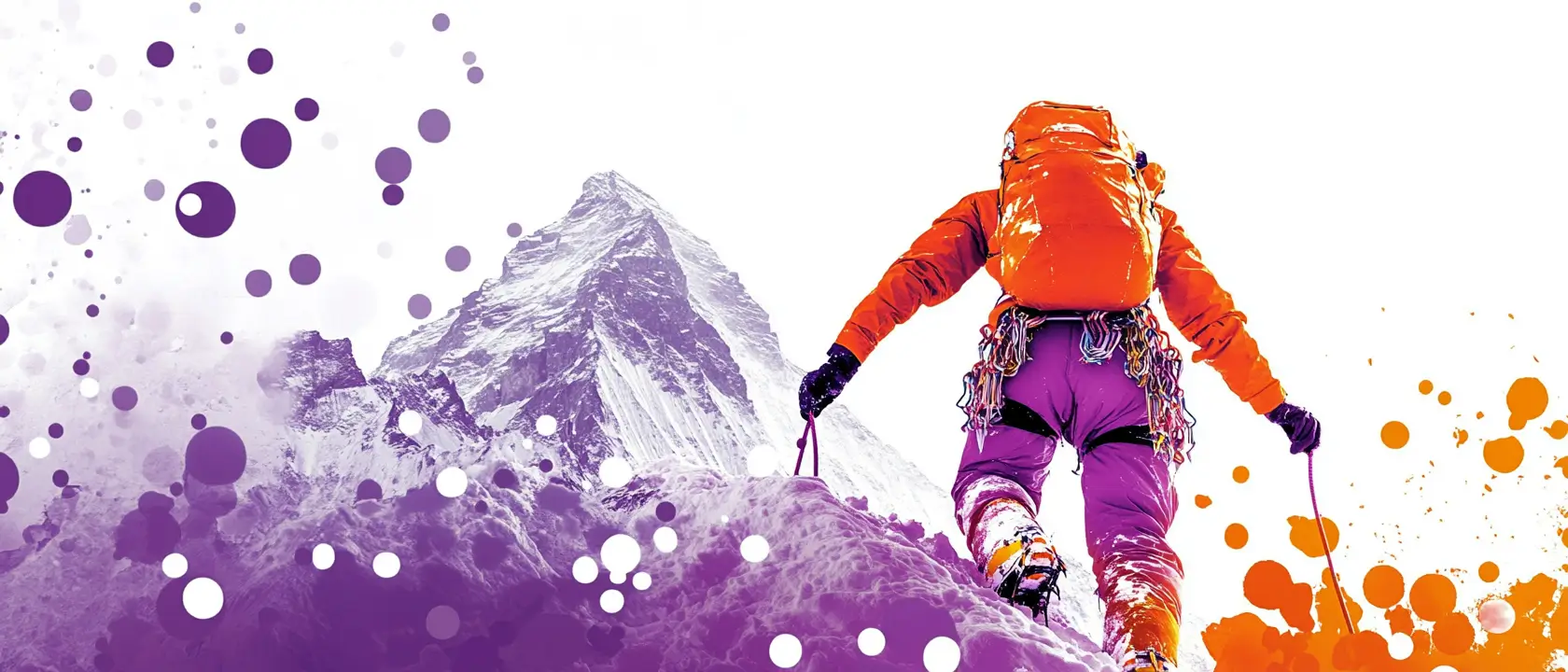
There's no question about it: when the journey into the unknown begins, the Explorer archetype is at the forefront. He or she stands for adventure and independence in the pursuit of personal freedom. They believe they can find this where others have not yet been. The good news is that Explorers are happy to take us regular folks with them on the journey and enable us to explore the world behind them.
Explorer archetype for brands:
Explorer brands want to give others the opportunity to experience the freedom that only they can feel. That's why they empower them to do so. In this context, freedom doesn't have to be literal, physical freedom. It can also mean financial freedom or choosing a better job.
Attributes:
- Promise: Freedom awaits.
- Desire/goal: Find yourself.
- Strategy: Explore the world.
- Strengths: A sense of adventure and independence.
- Weaknesses: Fear of stagnation or containment.
- Motivation: Freedom and self-determination.
Development phase:
Brands in this field can develop in many ways. An exemplary path can include different levels of orientation towards this archetype:
- Entry level: Find your own way (e.g. through inspiration in a subject area).
- Development level: Positioning as an enabler and problem solver in a specific topic area (e.g. through webinars or thematic introductions to financial independence).
- Expansion level: Redefine the world through new experiences (e.g. by offering experiences that cannot be found anywhere else).
Typical explorer brands:
Brands in this field want to help others to get ahead and follow their path. This can be in the outdoor sector (obvious), but above all includes all the areas in which brands help people to venture into new territory. Examples include:
- Patagonia
- Blinkist
- AirBnB
- Scalable
- Raffaello
2. Quadrant: "Ego"
Self-confident, self-centered and sometimes even a bit narcissistic. The archetypes in the “Ego” field rarely compromise. And brands in this field also know very well what the world needs them for. No question: if you are the measure of all things, to make the world a better place, others just have to follow you. And everything is fine. Simple, isn't it?
The Hero: Archetype

Those who take up the sword and slay dragons embody courage and determination. Ambition, power and tenacity are concepts associated with this archetype. Heroes value honor above all else and will do anything not to lose it. Compared to other archetypes, heroes are often perceived as very inspiring because they stand for change. This can also include change that comes at a price.
The hero archetype for brands:
Hero:in brands do not shy away from difficult challenges, but seek them out with determination to create a monument to themselves. Hero:in brands want to continuously test themselves and move forward. Brands that follow this archetype Heroic brands motivate their customers to overcome challenges, surpass themselves, and fight for what is right. It rarely gets cozy with heroic brands. Because the world is full of tasks if you are strong enough to take them on.
Attributes:
- Promise: You can change the world.
- Desire/goal: Showing courage and overcoming challenges.
- Strategy: Bold actions.
- Strengths: Courage, discipline and ambition.
- Weaknesses: Fear of failing.
- Motivation: Mastery and success.
Development phase:
Brands in this field can develop in many ways. An exemplary path can include different levels of orientation towards this archetype:
- Entry level: Emphasize your own strength (e.g. “Impossible is Nothing”).
- Development level: Challenging others to get the best out of themselves (e.g. often in the area of fitness challenges
- Expansion level: Pursue a larger mission to make the world a better place (e.g. tree planting or CO2 reduction projects).
Typical hero brands:
Brands in this field are constantly challenging themselves and others. They are typical for the sports and fitness sector. But other categories can also produce hero brands when it comes to great deeds and overcoming one's own weaknesses. Examples include:
- NIKE
- Weight Watchers
- FedEx
The Magician Archetype
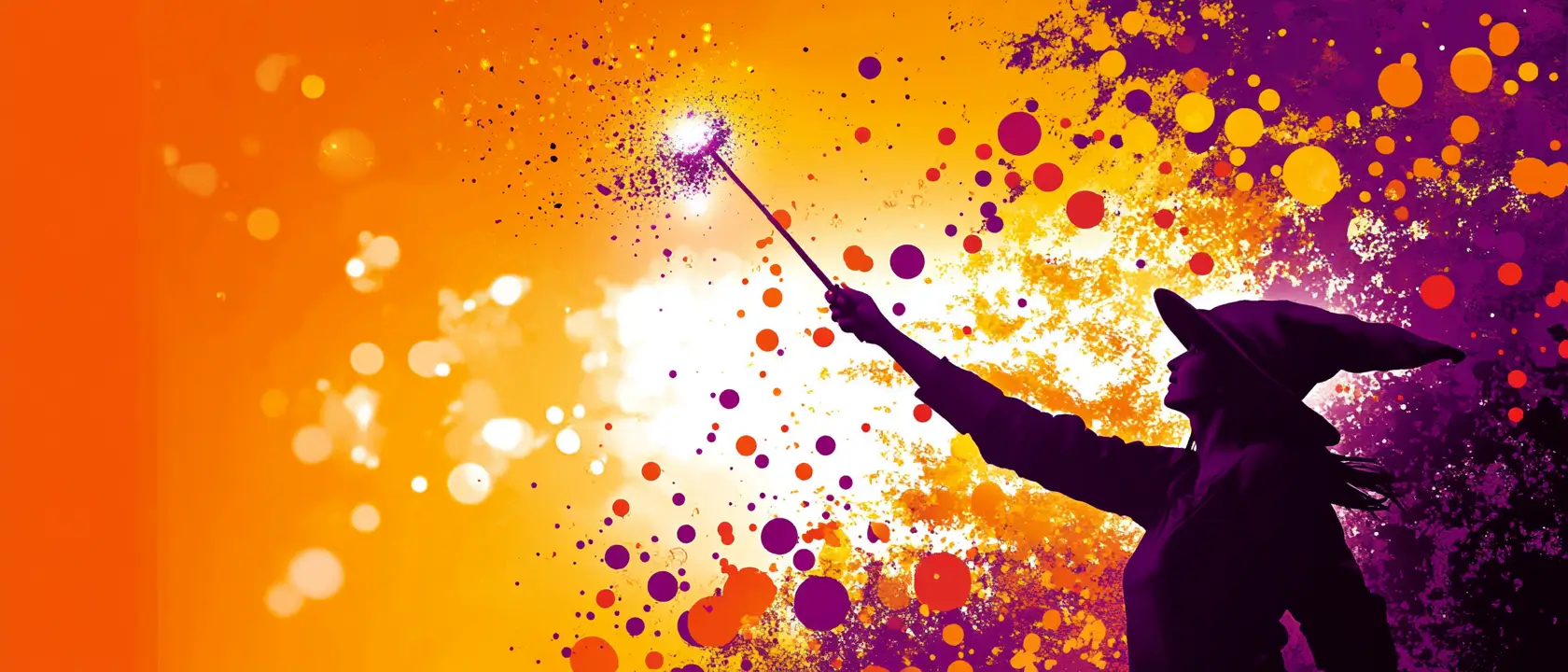
Who wouldn't want to wave a magic wand and change the world? Magicians stand for for transformation and dreams that they want to make come true. Their means to do so is their secret knowledge of how the world really works. Mage archetypes often have a spiritual or psychological component.
The magician archetype for brands:
Magician brands seek to expand our collective consciousness by creating the extraordinary and expanding the realm of the possible. In doing so, they transform us and the world around them. Magician brands create compelling experiences. They make their audience feel like “chosen ones” who stand out from the crowd and can achieve great things.
Attributes:
- Promise: Anything is possible.
- Desire/goal: Realizing transformation and visions.
- Strategy: Change through knowledge and innovation.
- Strengths: Vision and wisdom.
- Weaknesses: Fear of unintended consequences.
- Motivation: Transformation and renewal.
Development phase:
Brands in this field can develop in many ways. An exemplary path for brands can be:
- Entry level: Celebrate the magic and inspiration of the world (e.g. at Apple Keynotes).
- Development level: Major transformative changes that are brought about (e.g. transformative technologies).
- Development level:: Changing the world at a deep level and making it last (e.g. the world of Disney).
Brands in this field want to release the magic of the world and change us in an almost magical way. Either through experiences that they create for us, or by encouraging us to take transformative action:
- adidas
- Apple
- Red Bull
- OpenAI
The Rebel Archetype

Rebels disrupt the natural order of the world – for better or for worse. They can be activists, revolutionaries or visionaries. But they can also act as radicals. Fundamentally, they stand for the rebellion against norms and tradition. Rebels are rarely satisfied with the status quo and are not afraid to take the other world they want. Be it for selfish reasons or to improve the lives of others.
The rebel archetype for brands:
Rebel brands are usually loved for their courage to change the world and question everything. Rebel brands celebrate individualism and thrill-seeking, they break conventions and invite people to follow suit. Rebel brands are not always productive, however. If they overshoot the mark, they quickly lose friends or are perceived as being too ambitious.
Attributes:
- Promise: Rules are made to be broken.
- Desire/goal: Break down the status quo.
- Strategy: Question conventions.
- Strengths: Courage and provocation.
- Weaknesses: Risk of destruction without improvement.
- Motivation: Revolution and independence.
Development phase:
Brands in this field can develop in many ways. An exemplary path for brands can be:
- Entry level: Resistance to norms and alternative views of one's own actions (e.
- Development level: Major transformative changes that are to be brought about (e.g. disruptive concepts and startups).
- Development level:: Restructuring of the entire system (e.g. "Last Generation")
Typical rebel brands:
Brands in this field negate the status quo and want to fundamentally change it. They show us a different way of looking at the world and create a fait accompli in order to assert their view:
- Last Generation
- Patagonia
- DIESEL
- Uber
3. Quadrant: "Verbindung"
Humans are social beings. The archetypes in the “connection” target quadrant therefore primarily believe in a better world that comes about through social interaction. Team play and the interplay of diverse people count here. That's why brands that position themselves here usually create connections between people themselves or support them.
The Everyman Archetype

The Everyman represents honesty and a down-to-earth attitude. Even if it doesn't sound sexy, this important archetype is present in most of us. He or she wants nothing more than to belong and be part of a community that is doing well and in which he or she plays a role. He or she is the nice office neighbor who brings us coffee or the guy who brings his daughter to daycare in the morning and wishes us a good morning.
The Everyman archetype for brands:
The Everyman archetype is found in brands that value authenticity or normality. They strive to create things that are used in everyday life and seek out the moments when community is created. The Everyman does not want to attract attention at all costs, but wants to create value and have his/her place as part of a community. Brands that position themselves here usually avoid extravagance and unnecessary glitter.
Attributes:
- Promise: We are strong together.
- Desire/goal: Belonging.
- Strategy: Promoting community and collaboration.
- Strengths: Honesty and reliability.
- Weaknesses: Fear of being invisible or irrelevant.
- Motivation: Community and safety.
Development phase:
Brands in this field can develop in many ways. An exemplary path for brands can be:
- Entry level: As part of society, making life a little easier, more affordable or better for everyone (e.g. IKEA or H&M).
- Development level: Strengthening collaboration and guiding cooperation (e.g. Miro).
- Development level:: Creating a fairer society with equal opportunities (e.g. Aktion Mensch)
Typical everyman brands:
Everyman brands are important because they offer very basic products and services to us all. They make things accessible and affordable that used to cost a lot. They help and they lead cooperation. Everymen may not be as exotic as rebels, but they are needed by us all.
- IKEA
- H&M
- Lidl
- Aktion Mensch
The Fool archetype

On the surface, fools and jesters are all about fun and light-heartedness. But they have always been more complex than most people think. Jesters often led the crowned heads of state, who commissioned them. They usually knew very well what was going on at the royal court. Fun - for them, it was always a means of power and a mirror for the court society around them.
The jester archetype for brands:
Brands that follow the fool archetype stand for fun, spontaneity, and living in the moment. They bring lightness and joy by using humor and defying convention. They believe that laughter changes the world and that they can achieve their goals when the world around them is cheerful. However, they can also be ironic and may well contribute a social perspective to the comedy show.
Attributes:
- Promise: Bringing laughter and joy into life.
- Desire/goal: Experience fun and freedom.
- Strategy: Pushing boundaries through humor.
- Strengths: Optimism and playfulness.
- Weaknesses: Fear of not being taken seriously.
- Motivation: Joy and vibrancy.
Development phase:
Brands in this field can develop in many ways. An exemplary path for brands can be:
- Entry level: Representing simple fun and ease (e.g. through true-to-life and fun motifs in marketing)
- Development level: Develop and celebrate intelligent humor.
- Development level:: Focusing on a life full of fun and all the attributes that support such a life.
Typical fool/fools brands:
Fools' or jesters' marks can stand for light-hearted fun. And they can hold up a mirror to society and thus become socially critical. They are usually more complex than first meets the eye.
- Kinder Bueno
- Fanta
- Lego
- Old Spice
The Lover archetype

Obviously, lovers stand for Passion and relationship. They seek closeness and want to please. Relationships are the center of attention for lovers. To lead and structure these, lovers want to create special moments that only exist with him or her. But as is so often the case with archetypes: intimacy is one motive of this archetype, for this archetype, every form of relationship is the center of attention.
Lovers as archetypes for brands:
Brands that identify with this archetype like to celebrate pleasure, closeness and the experience of very special, exclusive moments. Lover brands want to create a closeness that only exists with them.This can be very personal. Or through luxury and premium orientation. No matter what: Lovers celebrate every single connection
Attributes:
- Promise: Experience true love and passion.
- Desire/goal: Connectedness and sensuality.
- Strategy: Offer emotional experiences and enjoyment.
- Strengths: Passion and dedication.
- Weaknesses: Fear of rejection or being rejected.
- Motivation: Closeness and intimacy.
Development phase:
Brands in this field can develop in many ways. An exemplary path for brands can be:
- Entry level: Brands celebrate beauty and pleasure (often in the food environment, for example)
- Development level: Brands create an emotional bond by making their exclusivity and enjoyment a lifestyle choice and personal orientation.
- Development level:: Brands celebrate an exclusive lifestyle and create experiences that can only be had with them (e.g. in a luxury environment).
Typical lover brands:
Lover brands want to celebrate exclusivity when it serves the human connection. Relationships drive the lovers' brands and that is why they stage themselves and their environment as the special
- Häagen-Dazs
- Tiffany's
- Chanel
- Rocher
4th quadrant: Order
Doesn't our world actually need much more structure? A clear concept of what works and what doesn't work and how to do things? The order archetypes strive for this ideal-typical state. They also want to improve the world. But not through liberation, adventure or team play. Rather through rules, structure and, of course, a little power.
The Ruler Archetype

The archetype of the ruler represents power and stability. Rulers try to take control to prevent chaos. Security and order are central needs when this archetype is about protecting the world from itself. Rules, guidelines, dominance: rulers see themselves as role models for others and want to stay in charge.
Rulers as archetypes for brands:
Brands that follow the ruler archetype generally reflect authority, control and leadership. They rely on authority, excellence, clear rules and dominance to take a leading position in the market. They are concerned with stability and security in a changing world. And they are aimed at customers who value structure, quality and success. No nonsense. Here, leadership is taken and given.
Attributes:
- Promise: Power rules the world.
- Desire/goal: Control and prosperity.
- Strategy: Leadership and clear rules.
- Strengths: Responsibility and authority.
- Weaknesses: Fear of chaos and loss of power.
- Motivation: Reliability and safety.
Development phase:
Brands in this field can develop in many ways. An exemplary path for brands can be:
- Entry level: Brands present themselves in unusual and exclusive contexts (e.g. IWC Schaffhausen)
- Development level: Brands define those in their community as “winners” and stage them (e.g. FAZ “There's always a clever mind behind it”).
- Expansion level: Brands celebrate power circles and exclusive networks that transform societies (e.g. Munich Security Conference)
Typical Ruler Brands:
Rulers strive for clear structures and/or circles in which they can set the tone. They want to create structures that are decisive for others and shape the surrounding society.
- Rolex
- Rolls Royce
- FAZ
- IBM
- Yves Saint Laurent
The Caretaker Archetype

Just like the other archetypes in this quadrant, the caretaker is also looking for structure. The way to achieve this is through their concern for the general public. Sensitive, compassionate, altruistic: these are the characteristics of this archetype. Compared to other archetypes, the caretaker shows parental tendencies in their concern for a positive community. A little volunteer work here and a small donation there? That's not enough for this archetype. Caring people serve to the point of self-sacrifice to protect those close to them from evil.
Caretakers as archetypes for brands:
At first glance, caretakers may appear one-dimensional, but they are not. They are creative when it comes to saving their fellow human beings from themselves. To do this, they use a whole range of tools to make the world a better place for those around them. Their structure is caring for others. They want to maintain and promote this because it is their primary function.
Attributes:
- Promise: You are safe and in good hands.
- Desire/goal: Caring for others and providing protection.
- Strategy: Show helpfulness and support.
- Strengths: Empathy and selflessness.
- Weaknesses: Fear of selfishness or exploitation.
- Motivation: Responsibility and care.
Development phase:
Brands in this field can develop in many ways. An exemplary path for brands can be:
- Entry level: Brands help others to find themselves (e.g. beauty products like Clinique)
- Development level: Brands offer a group a sense of security (e.g. health insurance).
- Development level:: Brands transform public welfare and support at the societal level (e.g. Telekom with the #Lichtan campaign)
- Volvo
- UNICEF
- Johnson & Johnson
The Creator Archetype

A new world emerging from brilliant ideas – that is what the creator archetypes are looking for. For this archetype, the focus is on the process of creation, including the creative process and the associated self-expression. Creator brands tend to long for freedom of expression in a non-conformist way. This is the outlet that allows them to feel in control of an otherwise uncontrollable world.
The Creator archetype for brands:
Brands that follow the creator archetype stand for innovation, creativity and originality. They inspire those around them to create new things and to use their imagination. These brands promote individuality and self-expression, and encourage people to realize unique works or ideas that push the boundaries of the known.
Attributes:
- Promise: You can create something unique.
- Desire/goal: To create a lasting work and shape the world.
- Strategy: Use your creativity and imagination.
- Strengths: Innovation, vision and originality.
- Weaknesses: Fear of mediocrity or failure to implement.
- Motivation: Self-expression and creation of something new.
Development phase:
Brands in this field can develop in many ways. An exemplary path for brands can be:
-
Entry level: Collect ideas and get creative
(e.g. DIY products or craft materials that encourage creative development). -
Development level: Realize your own projects and present them to others
(e.g. platforms for creatives or tools that make it easier to implement your own ideas). -
Expansion level: Creating visionary works that have a major impact
(e.g. renowned design or technology companies that drive innovation).
Typical creator brands:
- Tesla
- tiktok
- Jung von Matt
Abonnieren Sie unseren Newsletter
The superspring newsletter with our look at what's coming in marketing - and, of course, what we contribute to it. Sent out regularly and can of course be cancelled at any time.
How archetypes can improve brands
There are different ways in which brands can work with archetypes. At superspring, we like to use them in workshops to define a conceivable framework for our clients that their brand can span. The reason for this is simple: brand archetypes make it easier to define roles for brands. A “magician brand” acts and operates differently than a “caretaker brand”. It communicates differently, it feels different, it uses different iconography, it has a different tonality. This tool is extremely helpful for clearly visualizing these possible fields – both internally and externally.
Typical professional contexts for this are strategic branding contexts, such as go-to-market processes, Brand launches or relaunches. We also use it as a helpful tool in content strategy development and various other fields of application. So mostly in processes in which organizations ask themselves how they can achieve consistency in their brand story and how they can use various activation methods to ensure that it is consistently apparent.
In general, brand archetypes can be useful for defining the following brand- and marketing-related topics:
- Brand storytelling: How do we understand the story of our brand?
- Brand design / CD: How do we feel?
- Tonality: How do we speak?
- Values and guiding principles: How do we want to act?
- Communication: How do we communicate?
- Content and channel strategy: how and where do we communicate specifically?
Working with brand archetypes does not replace positioning. We use them as conceptual characters with strengths and weaknesses that help us open the door to our customers' storytelling and keep it consistent.
Concrete realization
Define your goal: Why work with archetypes at all?
Brand archetypes are conceptual tools. Every brand that works with them should be clear about what they want to get out of them. Do you want to create a completely new brand? Or are you looking to refine an already established brand? We believe that brand archetypes are particularly useful for the latter application. This is because they provide a good behavioral framework for brands that are looking for a more concrete link between the brand and, for example, communication. In addition, they are easy to understand and can therefore be easily communicated internally.
Workshop: What archetypal role does our brand play?
Those who can combine brand and archetype, for example in the context of a workshop, have a good starting point for self-reflection as a brand. Brand archetypes always come with strengths and weaknesses. They have goals and values. It is rare for an organization to be able to “choose” an archetype. However, well-formulated brand archetypes are a good starting point for most brands to reflect on themselves and define themselves as a communicating organization. Brands do not choose archetypes. Brands per se represent archetypes or combinations thereof.
Creating a framework: How does the archetype influence our brand storytelling?
Working with archetypes does not replace positioning. It is an exercise to substantiate and advance the content of essential elements of a brand identity in combination with a positioning. The role that an archetype takes can be further thought of in a framework for a brand story, in visual elements and in a brand mission statement. Archetypes can provide stability here and form a framework of understanding that supports the creation of unified narratives.
Communication. How do we make our brands speak?
Not only in the fundamental positioning but also in the application of a Communication Strategy archetypes can make a valuable contribution. Different archetypes appeal to different emotions and needs. A “rebel” brand has a different role than a “wise” brand. B2B. behave differently than digital D2C organizations. Archetypes can provide a framework for content strategies and their consistent implementation and can help formulate specific marketing assets with specific tasks that strategically fit the brand.
Brand evolution. Stay flexible.
Of course, the world changes, and your brand archetype strategy should be flexible enough to adapt. Stay open to the evolution of your archetype to keep pace with the changing needs and expectations of your customers. After all, brand archetypes are just a small tool for shaping your brand in a workshop context. Reality is where your brand has to prove itself 24/7 – and that includes a logical evolution of what was once formulated in
Conclusion: brand archetypes can help if you know where.
Brand archetypes are a great, intuitive concept for helping organizations to sharpen their brand role. Their strength lies above all in the clear images they paint, which are based on C.G. Jung's theory of universal images that we all know. This is precisely what makes them comprehensible. And this strength is also their greatest weakness.
Because when used as positioning tools, archetypes are, of course, not a scientific tool. They can help to fuel imagination and conception. They help to write better briefings. However, one should be wary of the magnetic force of certain archetypes in workshop contexts. Because when it comes to choosing between “the everyman” and “the creative”, every CMO would rather choose Steve Jobs than John Doe. But what if John Doe is the more suitable choice for the company?
Without a doubt, brand archetypes are not a sure-fire success. You have to know how to use them profitably to define brand guidelines, to support branding or to develop content strategies. Important: No brand archetype is a positioning or can replace it. However, if you use them as a supporting tool on the way to brand positioning, they can make an extremely valuable contribution.